





Eye For Film >> Movies >> The Fall Of Sir Douglas Weatherford (2026) Film Review


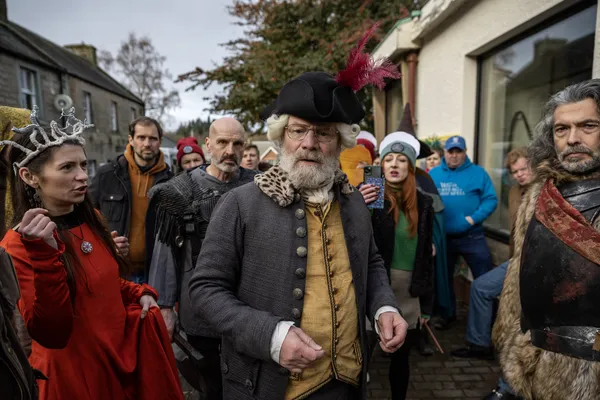

Kenneth (Peter Mullan) has perhaps always found it difficult to locate himself in society. It’s still harder now that he’s alone, affectionately patting the pillow beside his before going to sleep at night; bereaved for around a year, so we learn. Loyal dog Jessie does her best, as does granddaughter Anna, the only one whom he can still persuade to look at the family tree with him. He’s very proud of that family tree. It shows how he’s related to the Weatherford family who live in the big house nearby and dutifully employ him to look after their underperforming museum. It shows how they can all be traced back to the great Sir Douglas Weatherford, inventor, explorer, philosopher and poet, to whose memory Kenneth has devoted himself, dressing up, riding a horse or pointing out the sights from a tour bus: sights like specially positioned boulders which would be lost in the landscape were it not for their brass plaques.
“I think Grandad’s sad,” says Anna.
Kenneth’s life might not be a happy one but it is, he feels, a useful one. He is doing his bit to preserve history that would otherwise be forgotten, even if he doesn’t seem to give it much analysis. In a framing device which doesn’t entirely work, Sir Douglas himself provides intermittent pieces of narration. These often reference his famous deeds, which, to anyone not steeped in imperial propaganda (as many inhabitants of the British Isles remain to this day), frequently sound repellant, though of course they are elegantly phrased. For his part, Kenneth works really hard and is fluent in his recitations, successfully engaging small groups of tourists. Until, that is, the White Stag Of Emberfell crew comes to town.
All the real fans of the books hate the show, says local lad Stuart (Lewis MacDougall). He may or may not be right – perhaps our society is more accepting of cynicism than passion – but there’s certainly a huge public appetite for the production, which has chosen the countryside around their village to shoot in. Blocked from driving down familiar roads, drowned out by the noisy crew when giving speeches about Sir Douglas, Kenneth immediately finds his patience stretched, but nothing breaks his heart quite like arriving at his beloved museum to find it full of White Stag Of Emberfell tat. Soon he’s being dressed up as King Ergon and sent out to deliver White Stag Of Emberfell-based guided tours. He can see the history he loves disappearing beneath a tide of twee fantasy.
The White Stag Of Emberfell, to be fair, looks pretty bad. A trailer uses cobbled together lines lifted directly from Peter Jackson’s Lord Of The Rings adaptations. A key scene sees King Ergon clumsily slain with a jewelled sword by the series’ hero, who is played by absurdly popular and tragically incompetent actor Oskar (Jakob Oftebro), and it is on Oskar that Kenneth’s wrath comes to focus. As the star strives to get the leading role in an upcoming production of Hamlet, Kenneth finds himself playing Lear, separated from those he loves and gradually descending into madness .
It is, of course, Mullan’s film. He brings gravitas and emotional complexity to a story which could easily have collapsed otherwise. Oftebro is also good, unafraid of playing a weak man and able to make him feel human and likeable in spite of everything. This becomes vital because we need to care about them both as the story spirals towards its conclusion; we need to keep a clear perspective even as Kenneth’s becomes more and more disordered.
What is driving this disorder? It might be seen as symptomatic of a deeper social malaise in which history, truth, even our perception of reality face new threats. How far should we go to defend them? Adjacent to that is the question of why we tel stories. Might it be that thry sometimes enable us to contemplate deeper truths? There’s a hint of this in the film’s conclusion. Kenneth’s folly might be that he devotes himself with such singular passion to defending his particular approach to history that he loses sight of the possibility that there are other ways to go about it. In the immediate term, however, there are other things at stake, and what begins as a whimsical comedy takes on the qualities of a thriller.
Screened as part of the 2026 Glasgow Film Festival, where Mullan is a regular, The Fall Of Sir Douglas Weatherford sees him on fine form and would be worth watching for his performance alone. It’s an ambitious film which doesn’t always succeed in achieving its goals, and it’s unlikely to go down in history, but it makes itself heard.
Reviewed on: 07 Mar 2026


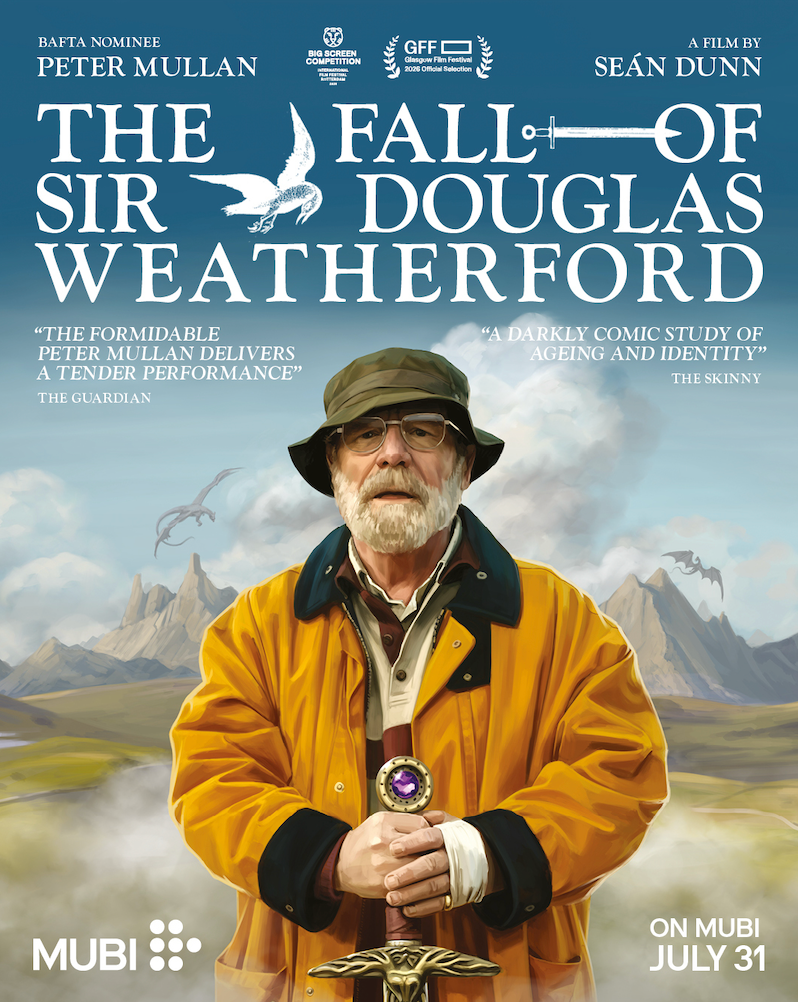

Director: Sean Robert Dunn
Starring: Peter Mullan, Jakob Oftebro, Lewis MacDougall, Sid Sagar, Saskia Ashdown, Cara Blease
Year: 2026
Runtime: 103 minutes
Country: UK
Streaming on: MUBI
Search database: